Antenna Polarization Explained: LHCP, RHCP, and Linear Antennas
A physics-to-hardware guide explaining circular polarization (LHCP/RHCP), linear antennas, matching transmitter and receiver antennas, multi-path interference rejection, and choosing antennas for range.
Antenna Polarization Explained: LHCP, RHCP, and Linear Antennas
FPV Antenna Polarization: LHCP vs RHCP Explained for Pilots
Ever wonder why your FPV video feed sometimes looks like a static-filled nightmare, even with expensive gear? The answer might not be your VTX power or receiver sensitivity, but something far more fundamental: antenna polarization. Specifically, understanding the critical difference between Left-Hand Circularly Polarized (LHCP) and Right-Hand Circularly Polarized (RHCP) antennas can be the key to unlocking crystal-clear FPV video and extending your range. Let's demystify this crucial aspect of your FPV setup.
For FPV pilots in Turkey and worldwide, optimizing every component of your video link is paramount. From choosing the right VTX to selecting the perfect goggles, each decision impacts your flight experience. Antenna polarization, though often overlooked, sits at the very heart of signal integrity. It's not just a technical detail; it's a practical necessity for stable, long-range FPV.
Understanding Antenna Polarization: The Basics
Before diving into LHCP and RHCP, let's establish a foundational understanding of what polarization means in the context of radio waves and FPV.
What is Polarization in FPV?
In the simplest terms, polarization refers to the orientation of the electric field of an electromagnetic wave as it propagates through space. Imagine a wave traveling towards you. The electric field component of that wave vibrates in a specific direction. This direction defines its polarization.
For FPV, this orientation is crucial because your transmitting antenna (on the drone) sends out waves with a particular electric field orientation, and your receiving antenna (on your goggles or ground station) needs to be aligned to "catch" those waves most efficiently. If they're not aligned, you lose signal strength, much like trying to fit a square peg into a round hole.
Linear vs. Circular Polarization
There are two primary types of polarization relevant to FPV:
-
Linear Polarization: The electric field vibrates along a single plane. Examples include:
- Vertical Polarization: The electric field oscillates up and down.
- Horizontal Polarization: The electric field oscillates side to side. Traditional whip antennas (like the stock antennas that come with many VTXs and VRX modules) are typically linearly polarized. While simple, they have a major drawback for FPV: if your drone banks or rolls, the orientation of its antenna changes relative to your receiver, causing significant signal loss. This is known as polarization mismatch.
-
Circular Polarization (CP): Instead of oscillating in a single plane, the electric field rotates as the wave travels. This rotation can be either clockwise or counter-clockwise.
- Why CP is Preferred for FPV: Circular polarization is the gold standard for FPV for several key reasons:
- Resilience to Orientation Changes: Because the electric field is constantly rotating, a circularly polarized antenna can maintain a much more consistent signal regardless of the drone's orientation. You can bank, roll, and pitch your quad, and your signal won't drop as dramatically as it would with linear antennas.
- Multipathing Rejection: In real-world flying environments, radio waves bounce off objects like trees, buildings, and the ground. These reflected waves arrive at your receiver slightly out of phase and with altered polarization, causing interference and signal degradation (known as multipathing). Circularly polarized antennas are inherently better at rejecting these reflected, phase-shifted signals, leading to a much cleaner video feed. This is arguably the biggest advantage of CP antennas for FPV.
- Why CP is Preferred for FPV: Circular polarization is the gold standard for FPV for several key reasons:
The Role of Polarization in Signal Stability
For any radio system, the efficiency of signal transfer between a transmitting antenna and a receiving antenna is maximized when their polarizations are perfectly matched. If they are mismatched, a significant portion of the signal energy is simply not received, leading to a weaker signal, reduced range, and increased static or video breakup. For FPV, where a clear, stable video link is critical for safe and enjoyable flight, matching polarization is not just important – it's absolutely vital.
LHCP vs. RHCP: The Core Difference
Now that we understand circular polarization, let's delve into its two distinct forms: Left-Hand Circular Polarization (LHCP) and Right-Hand Circular Polarization (RHCP).
Defining Left-Hand Circular Polarization (LHCP)
LHCP describes a circularly polarized wave where the electric field vector rotates counter-clockwise as it propagates away from the transmitter, when viewed from the perspective of the receiver looking towards the transmitter.
Think of it this way: if you point your left thumb in the direction the signal is traveling (from the transmitter to the receiver), your left fingers curl in the direction the electric field is rotating. This gives rise to the "left-hand" designation.
Defining Right-Hand Circular Polarization (RHCP)
Conversely, RHCP describes a circularly polarized wave where the electric field vector rotates clockwise as it propagates away from the transmitter, when viewed from the perspective of the receiver looking towards the transmitter.
Using the same analogy: if you point your right thumb in the direction the signal is traveling, your right fingers curl in the direction the electric field is rotating. Hence, "right-hand" polarization.
Crucially, LHCP and RHCP are mirror images of each other. They are opposite polarizations. This opposition is fundamental to their interaction, or lack thereof, when mixed.
Visualizing the Rotation
Visualizing this can be tricky. Here are a couple of mental models:
- The "Screw" Analogy: Imagine the radio wave as a screw. An RHCP wave would be like a standard screw (right-hand thread) that tightens clockwise as it moves forward. An LHCP wave would be like a left-hand thread screw, tightening counter-clockwise as it moves forward.
- The "Clock Face" Analogy: If you're looking at the transmitting antenna (e.g., on your drone) and imagine the signal coming directly towards your face, an RHCP signal's electric field will appear to spin clockwise, while an LHCP signal's electric field will spin counter-clockwise.
Many popular FPV antennas, such as the Lumenier AXII, Foxeer Lollipop, TrueRC Singularity, and ImmersionRC SpiroNET, are available in both LHCP and RHCP versions, often clearly marked with an 'L' or an 'R' on the antenna housing or connector.
The Critical Importance of Matching Polarization
This is where the rubber meets the road. Understanding LHCP and RHCP is academically interesting, but knowing the consequences of mixing them is paramount for any FPV pilot.
What Happens with Mismatched Polarization?
If you mix LHCP and RHCP antennas on your FPV system – for example, an LHCP antenna on your VTX and an RHCP antenna on your VRX (or vice-versa) – you will experience severe signal degradation and a drastic reduction in usable range.
Instead of your receiver efficiently capturing the transmitted signal, it will largely reject it. Your video feed will be filled with heavy static, breakup, and you'll likely lose video almost immediately after takeoff, even at very short distances. It will feel like flying with incredibly low VTX power, even if you're on 1W.
Understanding Cross-Polarization Rejection (XPR)
This signal rejection due to mismatched polarization is quantified by a term called Cross-Polarization Rejection (XPR). A good circularly polarized antenna is designed to be highly effective at receiving its intended polarization (e.g., RHCP) while simultaneously rejecting the opposite polarization (LHCP).
Typically, a well-designed CP antenna offers an XPR of around -20dB or more. What does -20dB mean in practical terms? It means that the receiver will only pick up about 1% of the transmitted power from a mismatched antenna. In other words, 99% of your precious signal is being thrown away!
Imagine flying with a 600mW VTX. With a -20dB mismatch, your receiver effectively only "sees" about 6mW of power. This is why a polarization mismatch is often the culprit behind frustratingly poor video range and quality, even when all other settings seem correct.
Why Even a Small Mismatch Matters
While a perfect circular polarization is ideal, real-world antennas aren't always perfect. The "circularity" of an antenna's polarization is measured by its axial ratio. A perfect axial ratio is 1.0 (meaning a perfectly circular pattern). As the axial ratio deviates from 1.0, the polarization becomes more elliptical, making it less effective at rejecting cross-polarized signals and potentially more susceptible to multipath interference.
Even with good quality antennas, slight imperfections in manufacturing or damage from crashes can slightly degrade their axial ratio. This means while they'll still perform well, they might not offer that absolute peak performance, especially in challenging environments. This is why investing in reputable brands known for quality control, like TrueRC, Lumenier, Foxeer, and TBS, can make a tangible difference.
Optimizing Your FPV Video Link with Correct Polarization
Now that we've established the "why," let's focus on the "how" to ensure your FPV video link is always optimized for maximum performance.
Consistency is Key: All LHCP or All RHCP
This is the golden rule, etched in the hearts of experienced FPV pilots: Ensure ALL antennas in your FPV video link share the exact same polarization.
This means:
- Your VTX antenna on the drone.
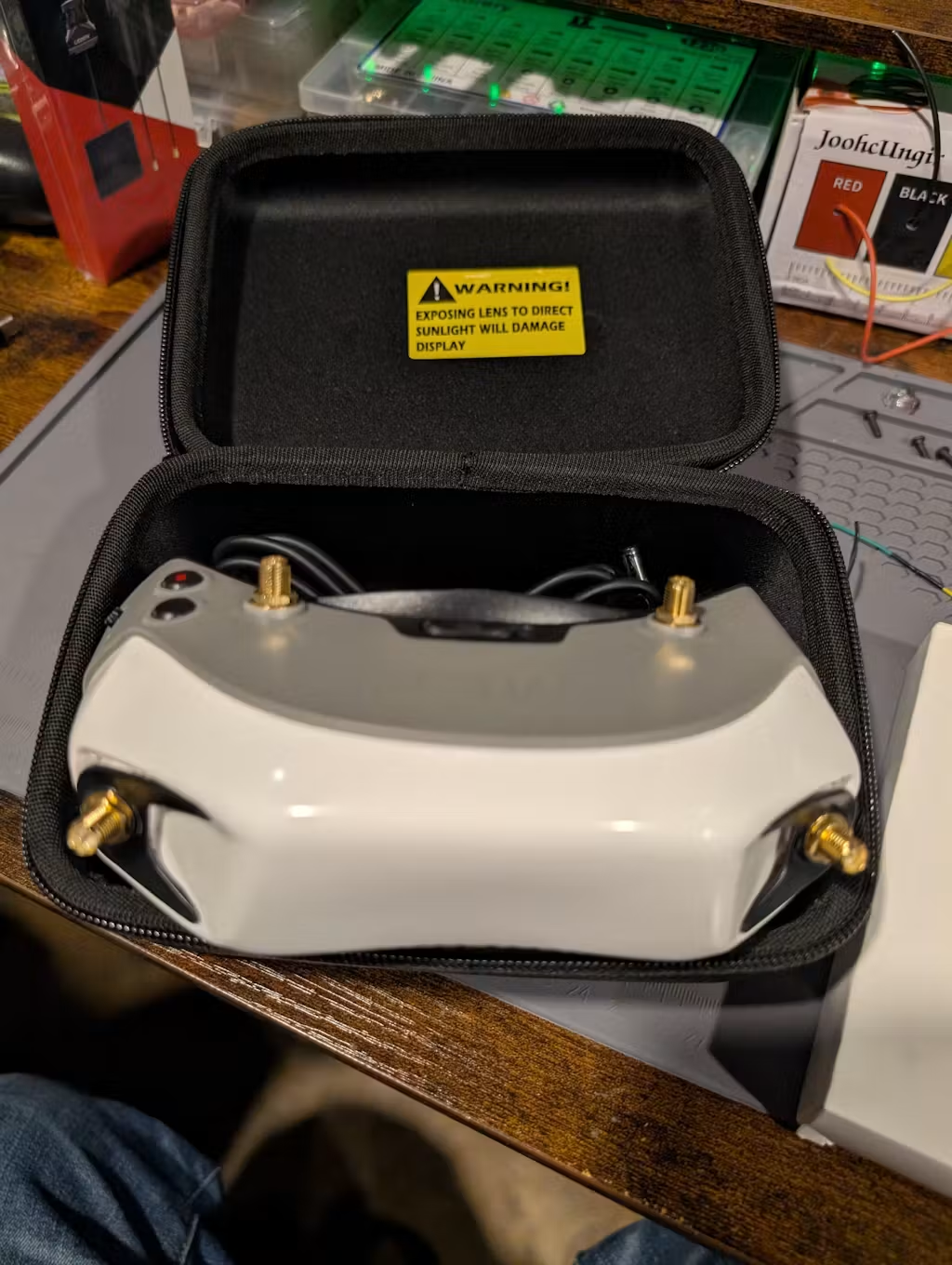
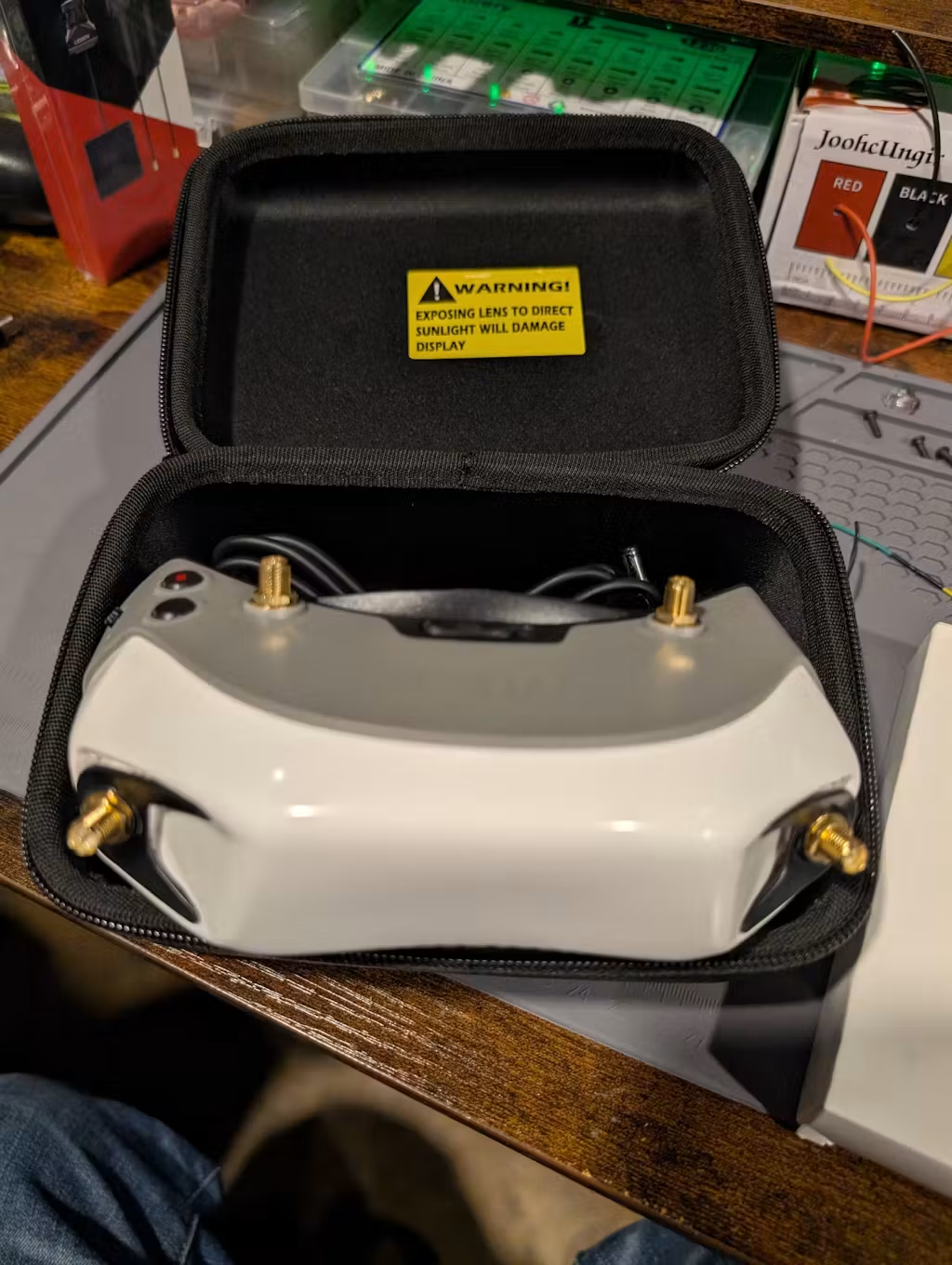
- All antennas on your VRX (receiver) module or FPV goggles (whether omnidirectional, patch, helical, or array).
If your VTX has an RHCP antenna, then all antennas on your goggles (e.g., a Lumenier AXII Stubby omni and a TrueRC X-AIR patch) must also be RHCP. If your VTX is LHCP, then all your receiver antennas must be LHCP. There are no exceptions if you want optimal performance.
Practical Tip: Before every flying session, make it a habit to quickly check the polarization markings on all your antennas. A quick glance can save you a lot of frustration.
Antenna Placement and Orientation
While circular polarization helps mitigate the effects of drone orientation, good antenna placement still makes a difference:
- Drone Antenna: Mount your VTX antenna as far away from carbon fiber, batteries, and other electronics as possible. Carbon fiber can block or reflect RF signals, creating dead spots. Orient the antenna vertically for best omnidirectional coverage, ensuring it's not tucked under the frame. For example, using a flexible extension like a pigtail can help position antennas like the Foxeer Lollipop V4 clear of obstacles.
- Ground Station/Goggles Antennas:
- Omnidirectional (e.g., AXII Stubby, Pagoda): These provide 360-degree coverage and are great for close-range flying or when the drone is directly overhead.
- Directional (e.g., TrueRC X-AIR, ImmersionRC Patch Antenna): These offer higher gain and longer range in a specific direction. When using a directional antenna, make sure to point it generally towards your flying area.
- Diversity Systems: If your goggles have a diversity receiver (like most modern FPV goggles such as the Fat Shark HDO3 or DJI Goggles 2/Integra), it's common practice to use one omnidirectional antenna and one directional antenna. Both must be the same polarization (e.g., both RHCP). The diversity system will automatically switch to the antenna receiving the strongest signal, giving you the best of both worlds.
Beyond Polarization: Axial Ratio and Antenna Quality
As mentioned earlier, the axial ratio is a critical specification for circularly polarized antennas. A perfect axial ratio of 1.0 indicates a perfectly circular polarization pattern. The closer an antenna's axial ratio is to 1.0, the better its performance will be in rejecting multipath interference and maintaining signal integrity.
High-quality antennas from reputable manufacturers like TrueRC, Lumenier, TBS, and Foxeer are designed and tested to achieve excellent axial ratios across their operating frequency range. While a cheaper antenna might look similar, its internal construction and tuning might lead to a poorer axial ratio, resulting in less effective circular polarization and, ultimately, a weaker video link. Investing in good antennas is often one of the best upgrades you can make for FPV video quality.
Choosing the Right Polarization for Your FPV Setup
So, should you go LHCP or RHCP? The good news is, there's no inherent performance difference between the two. One isn't "better" than the other in terms of signal quality or range.
Why Pilots Choose One Over the Other
The choice often comes down to two main factors:
- What's Common: Many pilots simply stick with whatever polarization is most common in their local flying community or what their first FPV gear came with. RHCP has historically been slightly more prevalent, but LHCP has gained significant traction, especially as more pilots become aware of its benefits for interference avoidance.
- Interference Avoidance: This is the primary strategic reason to choose one over the other.
Avoiding Interference from Other Pilots
Imagine you're flying with a group of friends, all on 5.8GHz. If everyone is using RHCP antennas, their signals, while on different channels, can still cause some minor interference with each other, especially if they are close in frequency or if one pilot flies directly between another pilot's VTX and VRX.
If you choose to fly with LHCP antennas while everyone else is on RHCP, your receiver will largely reject their RHCP signals due to cross-polarization rejection (-20dB or more!). This significantly reduces the chances of interference from other pilots, leading to a cleaner feed for you. Similarly, your LHCP signal will be largely rejected by their RHCP receivers. This makes choosing the opposite polarization a smart strategy for group flying.
Practical Tip: If you frequently fly with the same group, discuss and decide on a polarization strategy. Perhaps half the group uses LHCP and the other half uses RHCP to minimize mutual interference.
Checking Your Current Antennas
Before you buy new antennas or even your first FPV drone, check what you already have or what your friends are using.
- Look for Markings: Most quality FPV antennas will have "LHCP" or "RHCP" printed on them, or an 'L' or 'R' next to the brand name or model number.
- Visual Inspection (for Cloverleaf/Pagoda/AXII style):
- Hold the antenna with the connector pointing down and the lobes/elements pointing up.
- Look at the direction the elements are winding or twisting.
- If they twist clockwise as they go up, it's typically RHCP.
- If they twist counter-clockwise as they go up, it's typically LHCP.
- Note: This visual check can sometimes be ambiguous depending on the antenna design, so always prioritize printed markings.
Once you've determined your preferred polarization, ensure all subsequent antenna purchases for that FPV system adhere to that choice. Consistency is king!
Frequently Asked Questions About FPV Antenna Polarization
What is the difference between LHCP and RHCP antenna polarization?
LHCP (Left-Hand Circular Polarization) and RHCP (Right-Hand Circular Polarization) refer to the direction of rotation of an electromagnetic wave's electric field. LHCP waves rotate counter-clockwise, while RHCP waves rotate clockwise, when viewed from the receiver looking at the transmitter. They are mutually exclusive and cannot be mixed for optimal FPV signal.
Why is antenna polarization important for FPV drones?
Correct polarization matching is crucial for FPV to ensure maximum signal transfer, minimize signal loss due to multipathing (signals bouncing off objects), improve range, and maintain a stable, clear video feed. Circular polarization (both LHCP and RHCP) is preferred over linear polarization because it's more resilient to changes in drone orientation and better at rejecting reflected signals, which cause static.
What happens if I mix LHCP and RHCP antennas on my FPV setup?
Mixing LHCP and RHCP antennas (e.g., LHCP on your VTX and RHCP on your VRX) results in significant signal loss, typically around 20dB or more. This is known as cross-polarization rejection. In practical terms, this will severely reduce your video range to mere meters, cause heavy static, and lead to an almost unusable FPV feed, effectively wasting your VTX power.
How do I choose the correct antenna polarization for my FPV system?
There's no inherent performance difference between LHCP and RHCP; both are equally effective if matched. The best practice is to choose one (either all LHCP or all RHCP) and stick with it for all antennas in your system (drone VTX, goggles VRX, and any ground station antennas). Many pilots choose based on what's common in their local flying group to avoid interference from other pilots, or simply pick one and ensure consistency across all their gear.
Does antenna polarization affect FPV signal quality and range?
Absolutely. While the choice between LHCP and RHCP doesn't inherently affect quality or range, matching the polarization between your transmitting and receiving antennas is paramount. A mismatch will drastically reduce both signal quality and effective range due to severe signal rejection. Conversely, correctly matched circular polarization significantly enhances signal stability, clarity, and range by mitigating multipathing and maintaining consistent signal reception regardless of drone orientation.
Conclusion: Fly Clear, Fly Far
Understanding and correctly implementing antenna polarization is not just an advanced concept; it's a fundamental pillar of a reliable FPV system. By ensuring all your antennas are consistently LHCP or RHCP, you eliminate a major source of video static and signal loss, paving the way for clearer video, extended range, and a more enjoyable flying experience. Don't let a simple mismatch hold you back from your best flights.
Take a moment to check your FPV gear right now – are all your antennas perfectly matched? Share your polarization tips and experiences in the comments below!
Source: judgeme.imgix.net
judgeme.imgix.net