Motor Efficiency Engineering: Torque, KV Scaling & Thermal Dynamics
An engineering paper analyzing brushless motor efficiency, stator volume calculations, KV selection constraints, and copper losses under high-current flight loads.
1. Stator Physics & Electromagnetic Torque
Brushless FPV motors operate on electromagnetism. The torque $T$ generated by a stator is directly proportional to stator volume ($V = \pi \cdot r^2 \cdot h$), magnetic flux density $B$, and current $I$:
$$T \propto V \cdot B \cdot I$$
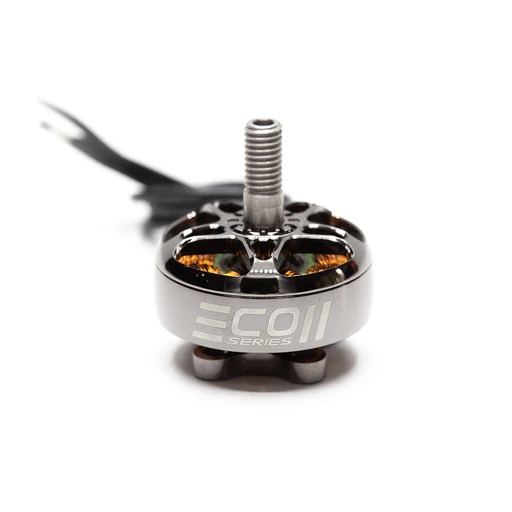
Increasing stator volume (e.g. from 2207 to 2306.5) shifts the torque curve, giving the multirotor more control authority over aggressive propellers.
2. The KV Parameter & Winding Constraints
The KV rating defines the motor's RPM per volt under zero load.
- Fewer Windings (High KV): Thick copper wire, low resistance, high current draw, extreme top-end speed, low torque.
- More Windings (Low KV): Thin copper wire, higher resistance, lower current draw, high torque.
2.1 4S vs 6S Scaling Dynamics
Running a lower KV motor (e.g. 1750KV) on 6S ($22.2\text{V}$) draws fewer amps for the same wattage output compared to a 2400KV motor on 4S ($14.8\text{V}$), lowering ohmic losses:
$$P_{loss} = I^2 \cdot R$$
3. Motor Thermal Runaway
Excessive current draw leads to thermal loading. If stators exceed $150^\circ\text{C}$, the neodymium magnets (typically N52SH grade) undergo irreversible demagnetization, causing permanent torque loss.
RELATED GUIDES
Copyright-safe media generated locally by FPVLovers