FPV Propeller Engineering: Disc Loading, Blade Pitch & Aerodynamic Drag
An advanced aerodynamic study of FPV propellers, detailing thrust-to-power calculations, pitch angles, disc loading constraints, and propwash interaction physics.
1. Propeller Aerodynamics
multirotor propellers generate lift by pushing air downwards. The thrust $T$ generated is mathematically defined by the momentum theory equation:
$$T = 2 \cdot \rho \cdot A \cdot v_i^2$$
Where $\rho$ is air density, $A$ is the disc area, and $v_i$ is the induced velocity of the airflow.
2. Aerodynamic Pitch, Blade Count & Grip
2.1 Propeller Pitch
Pitch defines the theoretical distance a propeller moves forward in one revolution.
- Low Pitch (e.g. 5x4.3): High efficiency, quick acceleration, low current draw, but lower top-end speed.
- High Pitch (e.g. 5x4.8 or 5x5.1): High top-end speed, but requires significant motor torque, draws extreme current, and suffers from heavy aerodynamic drag at low throttle.
2.2 Bi-Blade vs Tri-Blade Dynamics
- Bi-Blade: Lowest drag, highest thermodynamic efficiency. Ideal for ultra-light long range.
- Tri-Blade: Balanced grip, high thrust, linear throttle response. Standard for freestyle and racing.
3. Disc Loading & Airflow Contamination
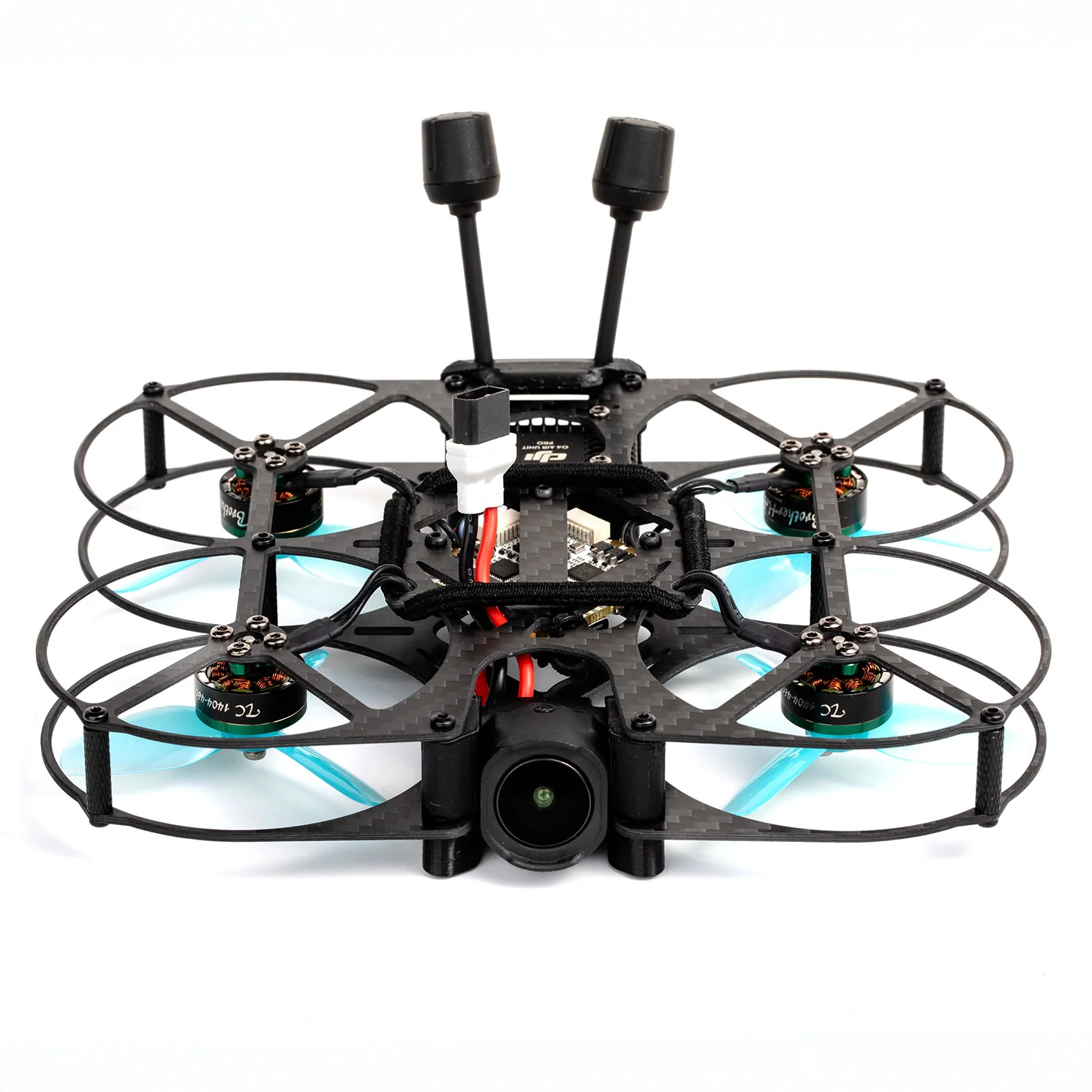
High disc loading occurs when a heavy multirotor uses small propellers (e.g. 3-inch cinewhoops). High disc loading leads to severe aerodynamic instability in descents, forcing the PID controller to work in highly turbulent vortex states.
RELATED GUIDES
Source: en.tmotor.com
en.tmotor.com